What fits above your car — planning overhead shelving around garage door tracks
Updated 2026-09-26
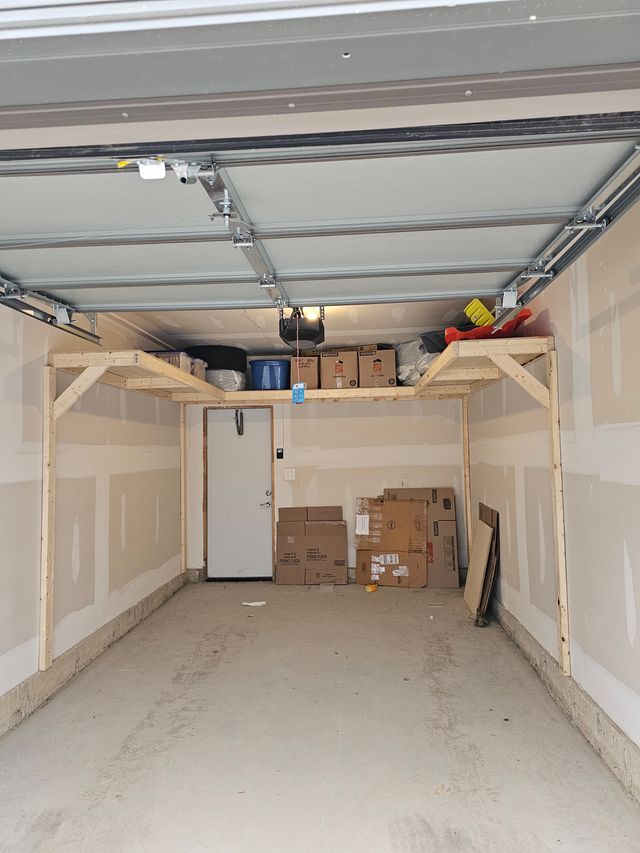
More than you think. In a typical Toronto garage, the strip above your car’s hood and the walls beside the door tracks are dead space — and they can hold every winter tire, bin, and hockey bag you own, as long as the shelving is planned around three things: the door tracks, the door’s travel, and where your car actually stops.
The three things that decide the layout
1. The tracks and the opener. The garage door’s rails run from the opening back along the ceiling, farther into the garage than most people register — usually with the opener rail between them. Nothing can live inside the door’s travel path. This is exactly why big-box shelving disappoints in garages: fixed panel sizes either sit under the tracks (too low, in your way) or can’t be mounted near them at all. A custom frame does the opposite — it’s cut to land above and beside the tracks, using the space they create. Look at the photo on this page: loaded shelves running right around the track. The door opens like the shelving isn’t there, because as far as the door knows, it isn’t.
2. The door’s high point. An open garage door doesn’t stay at the ceiling — it floats a few inches below its highest track point, and that height varies door to door. Shelf height gets set from the real door, the real opener, the real garage — measured with the door open, because that’s the honest number.
3. Where your car stops. Above the hood is prime storage: the car is lowest there, so shelving can come down lower and hold more without touching anything. The back wall of a single garage — the wall your bumper points at — is usually the best wall in the whole garage for deep shelving, and it’s where my 2-wall and 3-wall builds anchor the layout.
What actually goes up there
From the builds on this site: winter tires in the corner where two runs meet; storage bins two-deep along the long wall; sleds and seasonal gear on top where they’re out of the way until the season comes back. The pattern is always the same — the stuff you touch weekly stays reachable, the stuff you touch twice a year goes high and deep.
Depth: why 2 feet keeps winning
The calculator lets you pick 1 to 4 feet deep, and most builds land at 2. It’s deep enough for a tire, a big bin, or two regular bins nose-to-tail — and shallow enough that you can see and reach what’s at the back from a step stool. Go deeper than that above a car and you’re building a shelf whose back row you’ll never see again. Deep 3–4 ft shelving earns its keep where no car parks below it — mostly back walls — and the calculator prices it either way.
Measure once, then just text me
If you want to eyeball your own garage: door open, measure floor to the lowest point of the door/opener, and that’s roughly your clear height under any future shelf. Or skip the tape measure — text a photo of your garage (door open, one shot toward the door, one toward the back wall) to 647-933-8110 and I’ll tell you what fits, free, in about two minutes.